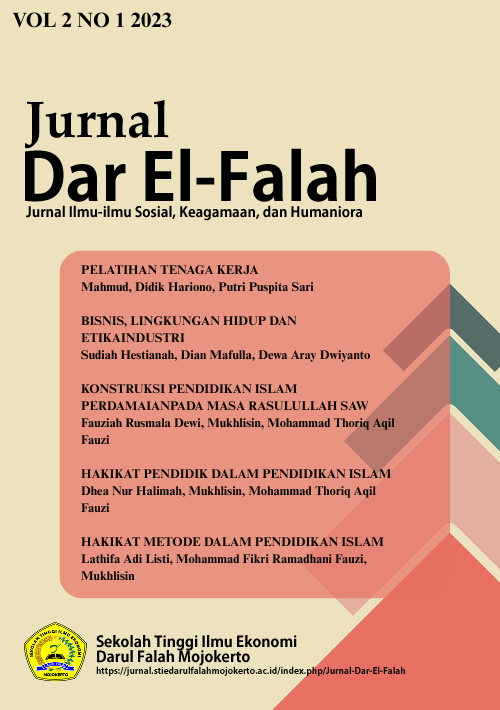
CONSTRUCTION OF PEACEFUL ISLAMIC EDUCATIONIN THE TIME OF THE RASULULLAH SAW
Keywords:
Construction, Islamic education, peace, the time of the Prophet SAWAbstract
Islamic peace education is an effort to create a peaceful, tolerant and
respectful society of differences. The concept of Islamic peace education
based on the Qur'an and Hadith is to create good and peaceful relations
between fellow Muslims, as well as maintaining the unity and unity of
Muslims by obeying the teachings of Allah SWT and His Messenger.
Islamic peace education emerged as a response to the development of Islam
as a major religion, as well as an effort to strengthen security and social
stability in society, in response to historical context, developments in science
and technology, the phenomena of globalization and pluralism,
strengthening unity, solidarity and harmonious relations between Muslims
and non-Muslim communities. Benefits and objectives of Islamic peace
education: (1) Forming a peaceful person, (2) Building harmonious
relationships, (3) Cultivating an attitude of empathy, (4) Maintaining unity
and unity, (5) Improving the quality of life, (6) Maintaining stability and
security , (7) Increasing understanding of the relationship between Islam and
peace, (8) Helping to build harmonious inter-religious relations, (9)
Fostering attitudes and behavior based on peace, (10) Reducing levels of
conflict and violence, (11) Encouraging community formation More
Inclusive. During the period of Rasulullah SAW in Mecca, the construction
of Islamic peace education was built through: (1) Building awareness of the
Oneness of Allah SWT., (2) Building the values of honesty and
trustworthiness, (3) Increasing social awareness and concern, (4)
Strengthening noble morals. The Islamic peace period of the Prophet
Muhammad in Medina is known as the Medina Agreement or Misaq Medina.
Peace construction steps: (1) formation of congregations or social groups
bound by the principles of justice and solidarity, (2) formation of agreements
bound by all social groups in Medina, (3) conflict resolution through
dialogue and deliberation.
Downloads
Published
Issue
Section
License
Authors retain copyright and grant the journal the right of first publication. Articles are distributed under the Creative Commons Attribution 4.0 International License (CC BY 4.0), permitting unrestricted use, distribution, and reproduction in any medium, provided the original work is properly cited.